Blog has moved, redirecting... ...

Showing posts with label grade4. Show all posts

Grade 4 Folk Song Unit: Making Alberta's History Sing (Part 4: Going Further)

by Rick Fawcett 

In this fourth installment of Grade 4’s Folk Song Unit series, I speak with Heather Fawcett and Jessica Kelly about the real “meat and potatoes” of their inquiry unit. They address the challenges a multi-dimensional project can present along with the manner in which student success is being measured.


In my role as Curriculum Portfolio Leader, I have been involved in each stage of this unit’s planning and I have been impressed with the amount of careful thought given by our Grade 4 team to each phase of this dynamic project.

Students are quickly entering the stage of the project that will see their songs being published. I believe you will be as impressed as I have been with the depth of learning that is happening in our Grade 4 Humanities program.

Grade 4 Folk Song Unit: Making Alberta's History Sing (Part 3: Sorting Out)

-by Heather Fawcett and Jessica Kelly

Through their guided research, students have compiled a wealth of information on an important element of Alberta's history. So, now what? Determining what information is important is a valuable research skill and this is what students are now doing. By giving students the challenge of creating songs, they must make some thoughtful decisions about what information is included in the lyrics. The success of their song hinges on their ability to extract the information that matters most, so sorting it all out is a crucial step in the process.

Students are beginning the song creation process by constructing their chorus. To support them in this crucial step, teachers have enlisted the help of two local singer/songwriters. Tanner James and John E. Buckle spent time working with students to help them construct their song's chorus. The conversations between students were not only helpful, but highly sophisticated. Students were using the language of historians as well as musicians.

Once students have a chorus, they will be building verses to further communicate the story of their historical topic. It should also be mentioned that students are being challenged to approach the story from different perspectives. Considering multiple perspectives is a main focus of the Alberta Social Studies curriculum, and the songs will honor at least two perspectives through their lyrics. How teachers will be assessing student learning will be topic of the next video.

Grade 4 Folk Song Unit: Making Alberta's History Sing (Part 2: Finding Out)

by Heather Fawcett and Jessica Kelly

 In Part 1 of “Making Alberta’s History Sing”, students were tuning in to topics for their folk song projects. Part 2 of the project challenges students to assert their research and questioning skills by compiling information on a chosen historical topic.

After a full day of exploring the various exhibits at the Glenbow, students had a variety of observations and questions about what they experienced. Through a teacher-led class brainstorm, everyone shared the topics that they found particularly interesting. The next step was to conduct some research into each of their options to see which stories had enough information available to support their song idea. Using guiding questions, students visited a variety of reliable digital resources including the Glenbow Museum archives.

With a primary song concept in mind, the focus of their research then shifted towards folk songs. Students were asked the question: What is a folk song? After listening to a variety of folk songs, students thought critically about the various elements that they heard. Students generated questions about folk songs which further guided their own research into this unique musical genre.

Connecting with experts is an important step in the inquiry process, so visits by local musicians Tanner James and John E. Buckle were arranged. Working with actual musicians went even further in helping students acquire a sound understanding of what makes folk songs unique. In addition to answering students’ questions, each artist performed a variety of songs and explained how they take a song from conception through to completion. This co-constructed criteria of a folk song will become the basis for their own work.

The first phase of the “Sorting out” process will challenge students to construct a catchy chorus using a 5-8 sentence summary of the event. Students will liaise with our musical experts during this step since it will involve some sophisticated and specialized language skills and knowledge. From there, the students will develop the verses using relevant historical information gained through their research.

Grade 4 Folk Song Unit: Making Alberta’s History Sing (Part 1: Tuning In)

by Heather Fawcett and Jessica Kelly

The Grade 4 Humanities teachers at Connect Charter School are currently designing an exciting unit of inquiry that provides students with an opportunity to create folk songs that communicate a story from Alberta’s rich history.

The design of this unit incorporates a number of Social Studies and English Language Arts curricular elements while also challenging students to express their knowledge and understanding through creative channels. Technology will play an integral role in the process and students will work directly with expert singer/songwriters to create folk song lyrics from their independent research findings. It’s an ambitious undertaking, but the potential for deep and profound learning is obvious.

The Inquiry Cycle 


Helping learners understand the various stages of the inquiry process, and what success means at each of those stages, is important in helping them reach their full potential as inquirers. If students have a firm grasp of what skills and behaviors befit strong inquirers, they know what it takes to be successful. To this end, the Grade 4 Humanities teachers have been working with the model pictured above. This framework also plays an integral role in the construction of inquiry units.

Energy Diet- A student post

Our grade 4 and 7 classes are collaborating this year in the Classroom Energy Diet Challenge. The students have been assembled into small combined teams where each takes up the different challenges. Our grade 7 students have taken up these leadership roles, and below is a blog post written by a grade 4 and 7 pair. They could earn up to 15 points for their team!

Energy Diet (Letter to the editor)
By: T and P

What are different types of energy sources? And which one is best for our environment?

Sun

Solar panels generate electricity from the sun. The old solar panels were made of silicon and now solar panels are made from cheaper crystals but do not work as well as silicon. Solar power is made when the suns light hits the solar panel, the electrons in the silicon get up and move instead of just jiggling in place to make heat.

An Inquiry into Words and Spelling

-by Abby Saadeh

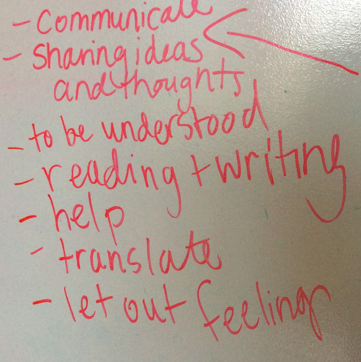
In an Inquiry based environment, we get excited and enveloped in our questions and ideas. At Connect Charter we want to take these opportunities to incorporate Spelling into our explorations and develop skills into our practice. Together with the Grade 4 Humanities team, we identified a need to develop some ideas on how to approach Spelling. I gave the students a Spelling Questionnaire that would give me more information about how they felt about Spelling and what they thought about themselves as Spellers. From the information gathered, I came up with the first discussion question, “What is Spelling?” And, “If we made Spelling important, what would it look like?” This is what the students came up with.

Class Brainstorm
Screen Shot 2014-02-26 at 11.35.50 AM.png

Next, we discussed words that they found interesting or were curious about because of the way they sounded or simply by the way they looked or how they sounded. I encouraged them to talk to each other about words that they found difficult, words that they continuously spelled wrong, or words that they spelled wrong in their previous assignments. We decided that we could get the words from anywhere, as long as they give reasons why they chose them, it could be from their writing, reading, signs, television...anywhere. We came up with a list of words that answered these questions and began to explore them.


Spatial Reasoning


Heather Melville- Grade 4 Math and Science

In July 2013, I had the privilege to work with students, teachers, Galileo Network experts and researchers at the University of Calgary. (Brent Davis – Professor and chair of mathematics education, Krista Francis Poscente – IOSTEM Director). We met in May to discuss the research portion of the spatial reasoning project. In that one day in May I discovered the importance of spatial reasoning as I went through my own testing and problem solving activities. I learned very quickly that this is a skill that needs to be taught and explored throughout our education. We cannot assume that everyone will be in an environment that allows for this particular skill to be enhanced. I am a believer in providing students with every opportunity to reach for goals that may potentially transpire into future careers. In discussion with the researchers and their knowledge, it was apparent that the careers people choose are based in part by what their spatial reasoning capabilities are.

Plant Growth and Changes

Flower Pounding in Grade 4
Marla Paxton~ Grade 4 Math and Science

Prep Time - A weekend (with breaks) to treat and prepare fabric
Lesson - Approximately 4-5 classes.

My partner teacher Heather Melville and I wanted to look at the way we took up Plant Growth & Change this year so the grade 4‘s made a lot of noise exploring the parts of a flower.  It all started with a picture book by Dianna Hutts Aston & Sylvia Long, A Seed is Sleepy.  Students looked at how seeds were sleepy, secretive, fruitful, adventurous, inventive, generous, ancient, thirsty, hungry, clever, and even sometimes naked!

CSS Podcasts: Assessing Website Credibility

Grades: 6-9
Subject: All

As part of our Collaboration and Outreach Program, the Calgary Science School is creating and sharing podcasts and PDF handouts of inquiry-based lessons designed by our teachers. We encourage feedback, comments and dialogue on the materials we publish.

This podcast contains one approach to assessing website credibility by introducing three criteria for students to use when conducting internet research projects.

These materials on website credibility were designed by The Critical Thinking Consortium, and are shared here with their permission.

How To Build an Awesome Car (Engineering Thinking in Grade 4)

Deirdre Bailey

Traditionally, Grade 4 "Wheels, Levers and Devices that Move" units involve hands on investigations in which students have the opportunity to build something. Often however, these building opportunities are heavily regulated and have students follow a specific set of instructions, put pieces together sequentially and then showcase a collection of virtually identical products.

While I can't pretend to know a whole lot about engineering, I am pretty confident that if the discipline were focused on building from instruction booklets, Chris Hadfield wouldn't have spent the last 6 months in space. As Dr. David Perkins' mentions in Making Learning Whole, kids don't learn to play the game if all they ever get are the pieces...


Grade 4/7 Plants Collaborative Project

Candice Shaw

The Grade 4 and 7 Math and Science teams were fortunate enough to attend the Calgary Science School/Rocky View Schools Cross Authority  STEM planning days in April. During these days, we were able to brainstorm, collaborate, and "flush out" a cross-grade collaborative unit. Both Grade 4 and 7 Science have units on Plants - Plant Growth and Changes (Grade 4) and Plants for Food and Fibre (Grade 7).

The initial vision for the unit was created by Carolyn Armstrong and Deirdre Bailey, when they attended the Cross Authority Environmental Stewardship planning days. When Heather Melville and I jumped on board, Carolyn and Deirdre had initial ideas for the cross-grade project, including the "spark" for the unit, essential questions, the focus on wellness, and initial thoughts for several activities (as discussed later).

On Light, Shadows and Experience

Deirdre Bailey and Jenna Callaghan

We began a recent investigation into Light and Shadows in Grade 4 by posing the question “What is Light?” to our students. Before beginning the conversation, we reminded students that the world is not nearly as concrete or easily-understood as over-simplified statements of "fact" might often imply. We talked about how scientists are by nature inquisitive, always open to possibility and a reinvention of old ideas. We suggested that throughout our inquiry, they too might have the potential to share a completely new perspective, contribute to making new discoveries and either support or disprove current thoughts. With two of us in the classroom, we were able to capture some of our students’ opening ideas about 'Light' and have embedded them below.

Pi Discoveries with Grade 4


Heather Melville ~Grade 4 Math/Science

What is Pi? Why are we celebrating Pi Day? Didn’t you spell Pi wrong Mrs. Melville?

March 14th turned into deep mathematical discussions for the 4.3 and 4.4 students. Rather than thinking the concept of Pi was too difficult for the students to comprehend, we explored what knowledge we already had and applied it to a new idea. Our math class began with a read aloud book titled; “Sir Cumference and the Dragon of Pi” by Cindy Neuschwander. We discussed the character names and what they were mathematically (radius, diameter, circumference, geometry and symmetry). The students loved to interact providing the sound effects for the story. 

Crowd Sourcing Fourth Graders

by Deirdre Bailey

Cross-posted on Savouring the Ish

I've got a novel on iPads in the grade four classroom waiting to be written. Lots of discoveries, ideas, struggles and triumphs. I just need to find the time to document it all properly. This brief gem, however, is too awesome not to share.

Earlier this year, our teaching team's excited discovery of the Edmodo app as an excellent resource for collecting and organizing student work digitally and providing an avenue for ongoing feedback was stinted by the limitation of only being able to upload images or links from the iPads. Our optimism was recently renewed by updates to the iWork apps which made it possible to upload pages, numbers and keynote documents directly to Edmodo. The latest struggle has been with how we might be able to have students download iWork templates we post to Edmodo and open them using the associated app. It seemed that the only way to open a doc from Edmodo was as a preview and frankly, I was beginning to think it wasn't possible any other way.

Nevertheless, while driving home from the mountains yesterday I posted a sample template for students to track their mousetrap car results to Edmodo via the numbers app with the comment "let me know if any of you figure out how to open this document as a numbers template!" Honestly, I didn't expect much. This morning I woke up to 17 replies...

Inquiring into Plant Growth and Changes in Grade 4

Amy Park and Deirdre Bailey

Earlier this year we had a pretty cool opportunity to connect with Mount Royal University professor Dr. David Bird to co-present on Plant Growth and Changes for the Calgary Science Network. We were most eager for an opportunity to ask Dr. Bird what one one thing he wished his university students came in with that we might be able to foster in elementary school. His answer was unhesitatingly curiosity. He wished his students arrived at university with a desire, confidence and ability to ask scientific questions. Overwhelmingly, many of them arrived reluctant to explore, preferring instead to wait for instructions on what to think or how to deliver in order to "pass the course".

Math & Science Inquiry Projects

CSS Math & Science Inquiry Projects Database

Our Math and Science Team has created a Google Doc to house a database of inquiry projects that they will use throughout the year. The goal of this database is to provide a place where teachers within the school and ultimately, teachers from outside the school, can see how we foster inquiry within our own classrooms.

If you would like to learn more about one of the projects or have a question please add a comment below.

Click here to visit the Project Database:
CSS Math and Science Inquiry Project Database

Collaboration: The Art of Strengthening


[Investigating the truth of opinions] consists not in trying to discover the weakness of what is said, but in bringing out its real strength. It is not the art of arguing but the art of thinking... the art of strengthening.
(Gadamer, 1975)

Abstract

Although there is substantial research supporting collaborative practices in school environments, definitions of the term vary widely. Most often, collaboration in schools remains limited to sharing resources or co-planning. A significantly prohibitive factor in allowing teachers to achieve mutually valuable, collaborative relationships are the perceived or established imbalances of power. Traditionally, collaborative arrangements implicitly assign authority to one member of a team or partnership over another (Awaya et al., 2003; Hellsten, Prytula, Ebanks, & Lai, 2009). Our journey this year has painted a picture of how re-thinking this historic relationship has the potential to allow for a more powerful collaborative relationship to develop, transforming teaching and learning in the classroom.

Google just keeps killing it.

by Deirdre Bailey,

I work at an innovative and creative institution. Perhaps it is because of the freedom we have to explore possibilities that we are often unaware of the depth to many of the simplest resources that are available. It is also without a doubt hard to be constantly adapting one's practice to ever-updating technology applications. Certainly, in this day and age, the sheer volume of resources available in education can be overwhelming. Navigating options and rating their relative value is always intimidating, particularly on the heels of a full 7 hours in front of students. But google docs is so worth it. In the last 9 months, it has become one of the most valuable learning tools for me as I continue to inquire into teaching and learning and I am constantly excited by the facility with which google docs allows me to guide student collaboration, research and writing while tracking their progress, providing feedback and involving parents. And while my presence on twitter often gives me the impression that all educators are connected, deeply familiar with technological resources and employing them in their every day practice; it occurred to me, after a conversation I had today that this might not be representative of all cases.

Connecting with an Expert: Grade 4 Humanities Picture Book Project

-By Heather Fawcett, Grade 4 Humanities

Through the Learning Through the Arts (LTTA) initiative, Grade 4 students at CSS had the opportunity to work with local artist, Val Lawton, to develop professional grade picture books. LTTA partners local artists with schools to facilitate rich integration of Fine Arts and the core curriculum.

The picture book project had students working in groups to write short stories set in one of Alberta’s natural regions. Magic in the Mountains, a picture book by Carol McTavish, Lori Nunn, and Linden Wentzloff, was used as a model for the project. Students were provided with graphic organizers and a checklist to guide the group development of their story. Our partner artist, Val Lawton, visited each class once a week to deliver art instruction and to assist in creating the illustrations for the books.

Time...


Inquiry takes time.  This has been a recurring theme, and one we have discussed at length, in our math/science class over the past few months.  If we want students to become proficient in any aspect of their learning, or life for that matter, we must give them time.  Time to wrestle with challenging issues. Time to celebrate small successes. Time to learn from mistakes. Time to listen to each other and time to grow.  When we rush kids through the learning process we deny them the necessary foundational blocks needed to develop into successful, self-directed learners.  The curriculum is filled with content and at times can seem overwhelming.  If we focus on “covering” each strand, then we lose sight of the big picture.  By pushing through the curriculum, we change the focus from being student centered to teacher centred.  This is not to say that the curriculum is not an important document. It is. However, as a professional, I see it as my responsibility to carefully read through the curriculum and determine what are the “need to know”, “nice to know” and “worth being familiar with” components – a model based on Wiggins and McTighe research.