Blog has moved, redirecting... ...

Showing posts with label environmental-education. Show all posts

An Inquiry into the Northern Gateway Pipeline

-by Greg Neil, Grade 7 Math/Science Teacher


In the Spring of 2014, I was looking for an engaging question that would connect to the Grade 7 Science Unit Ecosystems and Interactions. At the time, I was hearing a lot in the news about the Northern Gateway Pipeline and I had just secured a grant from ESRI to get training and support with their ArcGIS platform. This quickly developed into an ambitious idea for a major inquiry. I wanted my students to take the lead role in a comprehensive study of the Northern Gateway Pipeline (NGP)—a proposed project to transport oil and condensate along a 1,177 km route between Bruderheim, Alberta and Kitimat, British Columbia.

I adopted a student-led, inquiry-based approach to studying the pipeline, by simply asking students whether they thought it should be built. This quickly led to a huge list of questions that we would need to address in order to back up our opinions with sound reasoning. It was very important that my class develop informed opinions about the internationally publicized NGP and to understand the perspectives of as many stakeholders involved as possible. It was also important that my own opinions remain hidden in order to ensure my students were not influenced in any way.

My Grade 7 students drove the project themselves, formulating their own questions, mapping the planned pipeline route using ArcGIS, and researching its potential environmental and social impacts. We brought in guest speakers from Energy companies, Pipeline Companies and from Environmental Organizations. We even built a large scale model of the pipeline, to accompany our story map, which became the culmination of the students work, complete with a summary of their final decisions. Students even experimented on plants in order to learn about the potential impacts of chemicals entering the environment.

We presented our finished project at the Mayor's Environmental Expo, held every June in Calgary, where our students received an award for their hard work. The video below provides a visual tour of this project and click here for access to our Story Map.

Beyond the Destination: A reflection on outdoor education

-by Deirdre Bailey, Outdoor and Environmental Education Portfolio Leader
My favourite moment was every moment. The quiet is beautiful... 
When I was a kid, I used to see faces in everything. It’s been nice to find them again.
Grade 9 OE Student

Things I realized I forget to notice in the city: mountains, clouds and the way their shadows move across the peaks, baby trees, the sound of running water, the flight of birds. Awesome moments: getting to know people better, getting to know myself, diving into the glacial water, crossing streams, cooking by the creek, seeing the landscape at 7am.
Grade 8 OE Student

Grade 7 Recycling Centre Geometry

How to build a recycling centre?

Our grade 7 students were tasked with designing a recycling centre for each of the 4 homerooms in Geometer's Sketchpad. The result was a net that they printed onto a regular sheet of paper. Students then recreated the boxes from the printout to become scaled versions of the original.
their hallway. To begin the process they deconstructed a box and plotted the lengths, angles and shapes into

Magic Spots and Earth Walks

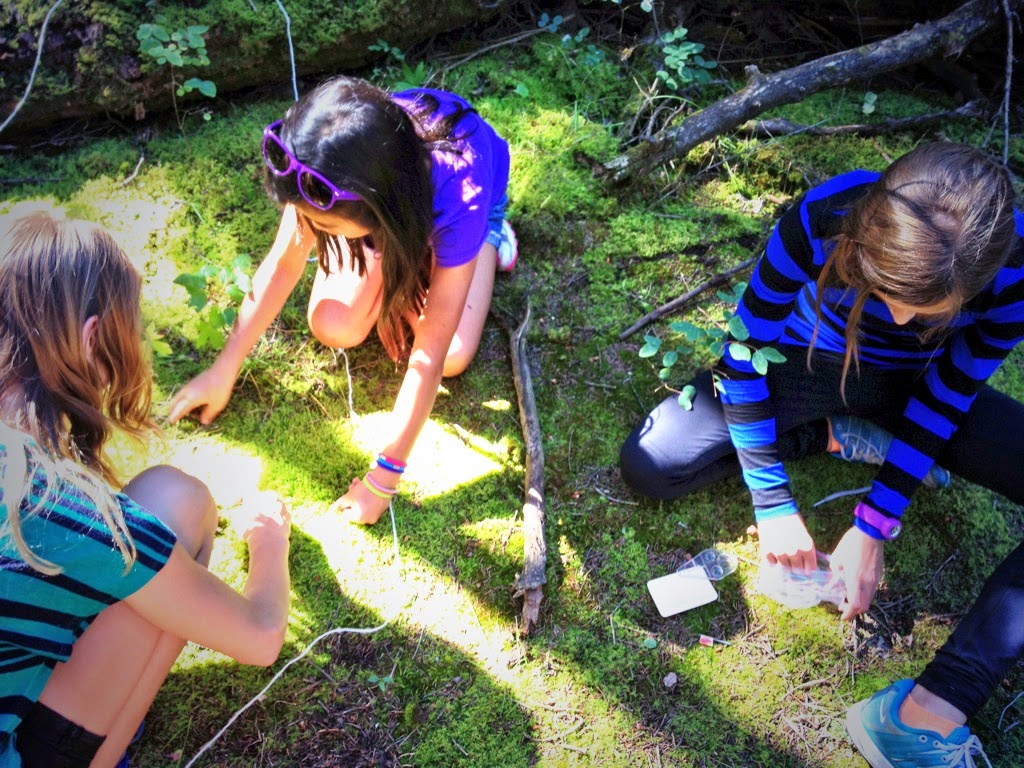
Here is a blog post that highlights some simple activities you can do with your students to get outside in the beautiful spring weather and have them investigating the natural world.  These activities can be done in your school yard or in a nearby natural area.

Since our early days the Calgary Science School has provided outdoor and environmental education experiences at Camp Sweet which is near Olds, Alberta. The camp, developed by former Calgary Science School principal Ron Sweet, has been used for the past 10 years to provide highly successful learning experiences for all CSS students in grades 4 to 9.

Each grade has two overnight camps per year where at least one of them is held at Camp Sweet. Our grade 7 students attended the 3-day and 2-night camp on their second week of school this year!

Energy Diet- A student post

Our grade 4 and 7 classes are collaborating this year in the Classroom Energy Diet Challenge. The students have been assembled into small combined teams where each takes up the different challenges. Our grade 7 students have taken up these leadership roles, and below is a blog post written by a grade 4 and 7 pair. They could earn up to 15 points for their team!

Energy Diet (Letter to the editor)
By: T and P

What are different types of energy sources? And which one is best for our environment?

Sun

Solar panels generate electricity from the sun. The old solar panels were made of silicon and now solar panels are made from cheaper crystals but do not work as well as silicon. Solar power is made when the suns light hits the solar panel, the electrons in the silicon get up and move instead of just jiggling in place to make heat.

Professional Networking Day for Outdoor Education teachers

Deirdre Bailey (Connect Charter), Jason Lindsay (Calgary Arts Academy) and David Manning (Westmount Charter)

“Passion is lifted from the earth itself by the muddy hands of the young; it travels along grass-stained sleeves to the heart. If we are going to save environmentalism and the environment, we must also save an endangered indicator species: the child in nature.” 
Richard Louv -  Last Child in the Woods
In collaboration with Outdoor Education specialists from the Calgary Arts Academy and Westmount Charter, Connect Charter School (formerly the Calgary Science School) is hosting a Professional Networking Day for Outdoor Education teachers on Monday, February 3, 2014. The intent to provide an opportunity and location for Calgary and area based Outdoor Educators to connect, share their unique approach to OE programming, and extend their professional community of practice. The primary purpose of the day is to allow attendees to share elements of their practice and in return, leave the day with new resources and contacts. Our goal is to allow for collaboration and feedback from a wide range of colleagues and mentors and to allow OE teachers to broaden their professional network in order to improve practice and advance the learning of colleagues.

Making Sustainable Food Choices

Originally Posted February 6, 2011


Our grade 9 team recently completed a cross-disciplinary 'challenge-based learning' project as part of an Apple/New Media Consortium international research study.

Challenge Based Learning is an approach to designing classroom work with many similarities to inquiry-based learning. CBL involves students engaging in real-world issues, conducting data-collection and analysis, and then designing and implementing a solution to an issue.

Grade 4/7 Plants Collaborative Project

Candice Shaw

The Grade 4 and 7 Math and Science teams were fortunate enough to attend the Calgary Science School/Rocky View Schools Cross Authority  STEM planning days in April. During these days, we were able to brainstorm, collaborate, and "flush out" a cross-grade collaborative unit. Both Grade 4 and 7 Science have units on Plants - Plant Growth and Changes (Grade 4) and Plants for Food and Fibre (Grade 7).

The initial vision for the unit was created by Carolyn Armstrong and Deirdre Bailey, when they attended the Cross Authority Environmental Stewardship planning days. When Heather Melville and I jumped on board, Carolyn and Deirdre had initial ideas for the cross-grade project, including the "spark" for the unit, essential questions, the focus on wellness, and initial thoughts for several activities (as discussed later).

CSS/RVSD Collaborative Planning


Greg Neil ~ Grade 6 Math/Science

I signed up for the Environmental Planning Institute in order to have the opportunity to collaborate with teachers from other schools.  After five years of teaching at the Calgary Science School, I craved the opportunity to see what was happening in other classrooms and how other teachers approached inquiry-based learning. 

During the tours of RVSD schools, I was immediately impressed with the way teachers approached student learning through rich questions that connected to numerous areas of the curriculum.  The inquiry questions I develop with my own students are often more directly connected to a specific discipline and do not always make strong connections between the Humanities and Math/Science curriculums.

Leave it to Beavers Project Update

Stakeholders in the Leave it to Beavers project met recently to reflect on fall visits and to plan ahead for spring and beyond.Rachelle Haddock from the Miistakis Institute summarized the fall program including the great news that a few 'nuisance' beaver were located and trapped to be introduced to the reservoir. http://www.rockies.ca/blog/?p=697
New Resident to Goodwin Pond by Rachelle Haddock

Recently volunteers at the site have seen evidence that the beaver are indeed still present and are busy logging the nearby forest. A blind has been built near the reservoir with a webcam focused on the beavers' dam, but we haven't been able to see the images yet. A new website for the project, which will include the scientific data produced by the grade 7 and 8 students, will hopefully host the webcam images.

Trees and Forests Inquiry Grade 6

Does the Weaselhead Natural Area produce enough oxygen to sustain Calgarians?

Greg Neil~ Grade 6 Math and Science

Our grade 6 students investigated this question in their Math/Science classes this year. The question was developed as part of a brainstorming session with students. This inquiry required the use of numerous mathematical skills, introduced students to the idea of assumptions and bias in Science, reinforced the need for accurate data and provided an authentic investigation into an important natural region close to the school. A current proposal to build a ring road through this natural area, made this project even more relevant and engaging for students.

After introducing the question, students started the investigation by gathering important background information. Sources such as Environment Canada, Statistics Canada and NASA were useful in establishing some basic facts about Oxygen production, current population and average values of Oxygen consumption by humans.

Inquiring into Plant Growth and Changes in Grade 4

Amy Park and Deirdre Bailey

Earlier this year we had a pretty cool opportunity to connect with Mount Royal University professor Dr. David Bird to co-present on Plant Growth and Changes for the Calgary Science Network. We were most eager for an opportunity to ask Dr. Bird what one one thing he wished his university students came in with that we might be able to foster in elementary school. His answer was unhesitatingly curiosity. He wished his students arrived at university with a desire, confidence and ability to ask scientific questions. Overwhelmingly, many of them arrived reluctant to explore, preferring instead to wait for instructions on what to think or how to deliver in order to "pass the course".

Bringing Beavers Back to the Cross Conservation Area – Site Visit #2

Parent Guest Blogger Denise Kitagawa Click here to visit "Out and About with the GeoKs" 

Our first visit to the Cross Conservation Area Pine Creek watershed was back in June. Against a backdrop of tall, green grass and leafy trees, a multitude of insects, toads and birds blessed us with natural “music” over the course of the day.

Things were a lot quieter during our second visit to the site, which took place in late September just after the students (now in grade 8) returned to school from their 3-day/2-night fall Outdoor Ed camp. The students were less boisterous than usual. A couple of ducks landed on the pond and took off a short while later. But most of the sounds were from a tractor and a crew of volunteers hard at work stockpiling small, felled trees and large branches at various locations around the pond, measures aimed at giving the beaver family (mature male, mature female, a juvenile and two 2012 kits) a better chance of making it through their first winter at the Pine Creek pond.

Preparation for Camp Sweet = Increased Chance of a Safe and Fun Experience

Parent Guest Blogger Denise Kitagawa
Click here to read the entire post and to see her stunning photography. 

One of the many amazing things about the Calgary Science School is the fact that students go on two overnight Outdoor Education trips each school year. One trip is to Camp Sweet (about 90 minutes outside of Calgary), where the students sleep in tents and spend a few days camping and exploring the woods and fields – including some free time splashing in the river if it’s warm enough. The other trip is grade dependent. This year, five out of six grades (500 students) are going to Camp Sweet between mid-August and the end of September (the grade 9 fall trip was to the Bamfield Marine Station on Vancouver Island).

Student Blogs "The Bamfield Diaries"

Student Guest Bloggers from grade 9

As a way to create an audience for their work, recently the grade 9 classes have begun blogging. As part of this process, students were asked to recount an experience they had during their week long adventure at Bamfield Marine Centre on the west coast of Vancouver Island. Here are some samples of their work along with their blog address.

Students love when people visit their blog (we are keeping a class tally for the blogs with the most posts). Please visit their site and feel free to leave a comment.


Bringing Beavers Back to the Cross Conservation Area - Grade 7 Interactions and Ecosystems Field Study

-by Denise Kitagawa (Guest Parent Blogger)

Earlier this month I had the privilege and pleasure of accompanying fifty grade 7 students from the Calgary Science School as they headed into the field to collect some baseline observations prior to the reintroduction of beavers to the Pine Creek watershed at the Ann and Sandy Cross Conservation Area.

Learning Off the Grid! The beginning...

-by Greg Neil, Grade 5 Math/Science

Editors note: Greg's classroom was just featured on Canadian Geographic's the Energy Diet Challenge. One of Greg's students recently wrote a letter to the editor of the Calgary Herald. To read that letter, click here.

As a science teacher at the Calgary Science School, I am always looking for ways to engage my students in rich, authentic learning experiences. When planning for the Grade 5 Electricity Unit, I was looking for ways to move beyond the basic outcomes associated with this unit and to tie our learning to a more meaningful project that promotes ethical citizenship and environmental stewardship.

Students into Scientists

by Deirdre Bailey and Amy Park

It began with a conversation on how best to develop deep understanding of biological cycles. When we considered simply slicing fruit and vegetables in half and leaving them out in the open to observe the resulting changes, we never anticipated the smells, the new life, or the learning that would ensue.

The suggestion that we use Google Docs to facilitate collaboration and data management through the scientific process provided an excellent opportunity for introducing students to the incredible value of facilitating collaborative research and documentation through technology. See examples of our student work in Google Docs linked here.

From Day 1 to Day 12, our young scientists were engaged, excited, and passionate about their discoveries. Throughout the process, students developed deep understanding of decomposition, the scientific process, collaboration, problem solving, data analysis, and so much more.

The following video outlines the entire process and the amazing learning that resulted.


Inquiring into Waste and Our World

by Deirdre Bailey and Amy Park

Our Grade 4 classes have spent the past three months inquiring into the topic of "Waste and Our World" with the goal of developing an appreciation and understanding of their roles and responsibilities as global citizens of this environmentally fragile and increasingly endangered planet. We had hoped that our inquiry would help students feel empowered to sustain environmentally conscious action as part of their everyday lives.


Our first mission was to collect garbage from the school ground. Students were shocked to discover that we had collected over 4lbs of lunch-related waste in one day and that this amount was repeated by the following class the next day! This activity made it clear that action for the environment was needed and could have a very real effect in our immediate community. As a group, we concluded that one minute public service announcements highlighting a need for change in our daily practices would be the best way to inform our school peers and inspire action.

These Kids Get It!


Today was amazing for a number of reasons.

We finished our decomposition lab this morning. It had been an enlightening few weeks of learning what becomes of a perishable food, halved and left in the open for three weeks. Some awesome things happen to rotting fruit after it starts to smell, not least of which are fluid loss and bacteria growth. This morning, the tomato had given birth to a new family of fruit flies, all of whom remained happily trapped under the wrapping as our young scientists whooped victoriously while pressing their faces to the creeping mass of molding vegetable.