-by Erin Piper
As a charter school, it is one of our mandates and goals to connect and learn with other teachers and school jurisdictions. Innovate West, most recently held May 23-25, 2014, is one of the ways we facilitate in bringing together a growing community of innovative educators to celebrate the many great things happening in education today. We believe that this event, and the people involved, truly reflects the vision and values of Inspiring Education.
This short video depicts how this experience resonated with participants:
For more information on the most recent conference, see this blog post.

Innovate West Wrap Up

by Dan McWilliam
Our school is still reverberating from the energy and ideas at Innovate West this past weekend (May 23-25, 2014). This was our third year hosting a connected group of innovative educators from Western Canada and beyond. These educators are the 'grassroots' who have developed a social support network online and Innovate West provides the physical meet up of the social network.
The Conference celebrates people and provides them the time and space to share, discuss and develop innovative ideas for education. The conference format begins with a tour of Connect Charter School classrooms on an operational school day where students and teachers share what they are working on and are available to conference delegates. Facilitated discussions are scheduled for Saturday and Sunday with an emphasis on participation. This connected group of educators continue to work together and inspire each other through the year via social media, Edcamps, networking days, and more.
Learning Freedom
-by Carly DeBoice (Connect Charter School Student-teacher Alumni and Substitute Teacher)
Occasionally, how students articulate an idea is much more eloquent than that of the teacher. So, I’ll use their words to help me explain the concept they coined today, “Learning Freedom.”
 This arose out of a request for each class to nominate two students to join a team who will help visitors during the upcoming Innovate West conference. Choosing a few students can be a tricky task for teachers. To find a handful of students who were genuinely up for the task, students were asked answer the following question, “What is your favorite thing about Connect Charter School?”
It is important to note that the students wrote individually, without any discussion or prompting. The similarity of many student responses was fascinating. George was explicit, saying, “My favourite thing about Connect Charter is the freedom we are given. Connect Charter lets us have freedom to solve problems any way we want.” Rowan takes this idea further and explains, “I love the freedom because we give you the freedom of how to think, how to feel, and how to learn. In this school everyone is respected for their learning choices. We think this is important because everyone has a different learning way. We believe that everyone is different, and we should have the freedom to be different!”
Occasionally, how students articulate an idea is much more eloquent than that of the teacher. So, I’ll use their words to help me explain the concept they coined today, “Learning Freedom.”
This arose out of a request for each class to nominate two students to join a team who will help visitors during the upcoming Innovate West conference. Choosing a few students can be a tricky task for teachers. To find a handful of students who were genuinely up for the task, students were asked answer the following question, “What is your favorite thing about Connect Charter School?”It is important to note that the students wrote individually, without any discussion or prompting. The similarity of many student responses was fascinating. George was explicit, saying, “My favourite thing about Connect Charter is the freedom we are given. Connect Charter lets us have freedom to solve problems any way we want.” Rowan takes this idea further and explains, “I love the freedom because we give you the freedom of how to think, how to feel, and how to learn. In this school everyone is respected for their learning choices. We think this is important because everyone has a different learning way. We believe that everyone is different, and we should have the freedom to be different!”
Grade 4 Folk Song Unit: Making Alberta's History Sing (Part 3: Sorting Out)
-by Heather Fawcett and Jessica Kelly
 Through their guided research, students have compiled a wealth of information on an important element of Alberta's history. So, now what? Determining what information is important is a valuable research skill and this is what students are now doing. By giving students the challenge of creating songs, they must make some thoughtful decisions about what information is included in the lyrics. The success of their song hinges on their ability to extract the information that matters most, so sorting it all out is a crucial step in the process.
Students are beginning the song creation process by constructing their chorus. To support them in this crucial step, teachers have enlisted the help of two local singer/songwriters. Tanner James and John E. Buckle spent time working with students to help them construct their song's chorus. The conversations between students were not only helpful, but highly sophisticated. Students were using the language of historians as well as musicians.
Once students have a chorus, they will be building verses to further communicate the story of their historical topic. It should also be mentioned that students are being challenged to approach the story from different perspectives. Considering multiple perspectives is a main focus of the Alberta Social Studies curriculum, and the songs will honor at least two perspectives through their lyrics. How teachers will be assessing student learning will be topic of the next video.
Through their guided research, students have compiled a wealth of information on an important element of Alberta's history. So, now what? Determining what information is important is a valuable research skill and this is what students are now doing. By giving students the challenge of creating songs, they must make some thoughtful decisions about what information is included in the lyrics. The success of their song hinges on their ability to extract the information that matters most, so sorting it all out is a crucial step in the process.Students are beginning the song creation process by constructing their chorus. To support them in this crucial step, teachers have enlisted the help of two local singer/songwriters. Tanner James and John E. Buckle spent time working with students to help them construct their song's chorus. The conversations between students were not only helpful, but highly sophisticated. Students were using the language of historians as well as musicians.
Once students have a chorus, they will be building verses to further communicate the story of their historical topic. It should also be mentioned that students are being challenged to approach the story from different perspectives. Considering multiple perspectives is a main focus of the Alberta Social Studies curriculum, and the songs will honor at least two perspectives through their lyrics. How teachers will be assessing student learning will be topic of the next video.
Grade 4 Folk Song Unit: Making Alberta's History Sing (Part 2: Finding Out)
by Heather Fawcett and Jessica Kelly
In Part 1 of “Making Alberta’s History Sing”, students were tuning in to topics for their folk song projects. Part 2 of the project challenges students to assert their research and questioning skills by compiling information on a chosen historical topic.
After a full day of exploring the various exhibits at the Glenbow, students had a variety of observations and questions about what they experienced. Through a teacher-led class brainstorm, everyone shared the topics that they found particularly interesting. The next step was to conduct some research into each of their options to see which stories had enough information available to support their song idea. Using guiding questions, students visited a variety of reliable digital resources including the Glenbow Museum archives.
 With a primary song concept in mind, the focus of their research then shifted towards folk songs. Students were asked the question: What is a folk song? After listening to a variety of folk songs, students thought critically about the various elements that they heard. Students generated questions about folk songs which further guided their own research into this unique musical genre.
Connecting with experts is an important step in the inquiry process, so visits by local musicians Tanner James and John E. Buckle were arranged. Working with actual musicians went even further in helping students acquire a sound understanding of what makes folk songs unique. In addition to answering students’ questions, each artist performed a variety of songs and explained how they take a song from conception through to completion. This co-constructed criteria of a folk song will become the basis for their own work.
The first phase of the “Sorting out” process will challenge students to construct a catchy chorus using a 5-8 sentence summary of the event. Students will liaise with our musical experts during this step since it will involve some sophisticated and specialized language skills and knowledge. From there, the students will develop the verses using relevant historical information gained through their research.
In Part 1 of “Making Alberta’s History Sing”, students were tuning in to topics for their folk song projects. Part 2 of the project challenges students to assert their research and questioning skills by compiling information on a chosen historical topic.
After a full day of exploring the various exhibits at the Glenbow, students had a variety of observations and questions about what they experienced. Through a teacher-led class brainstorm, everyone shared the topics that they found particularly interesting. The next step was to conduct some research into each of their options to see which stories had enough information available to support their song idea. Using guiding questions, students visited a variety of reliable digital resources including the Glenbow Museum archives.
Connecting with experts is an important step in the inquiry process, so visits by local musicians Tanner James and John E. Buckle were arranged. Working with actual musicians went even further in helping students acquire a sound understanding of what makes folk songs unique. In addition to answering students’ questions, each artist performed a variety of songs and explained how they take a song from conception through to completion. This co-constructed criteria of a folk song will become the basis for their own work.
The first phase of the “Sorting out” process will challenge students to construct a catchy chorus using a 5-8 sentence summary of the event. Students will liaise with our musical experts during this step since it will involve some sophisticated and specialized language skills and knowledge. From there, the students will develop the verses using relevant historical information gained through their research.
Student Learner Profiles: Student Voices
A Path to Digitial Student Learner Profiles: Student Voices
by Tanya Stogre and Abby Saadeh
At approximately the midway point of the Student Learner Profile Pilot using Pathbrite, we wanted to ensure we were hearing what students had to say about their experiences. We endeavoured to include a range of student voices. In an informal conversation, we asked students the following questions:
 • Do you like using Pathbrite, why or why not?
• Do you think using Pathbrite for your Student Learner Profile (SLP) has or could help you understand more about yourself as a learner?
• If your teacher next year said that they would be using Pathbrite to continue the work you have started on your SLP, how would feel?
After conversing with 11 Grade 7 students, several insights emerged from our discussions. One of the key ideas arising was that Pathbrite was user friendly. One student commented, “It’s easier than most other websites that we used. It’s more simple than others and straightforward. It doesn’t have a bunch of unnecessary items that you won’t need or ever use.”
by Tanya Stogre and Abby Saadeh
At approximately the midway point of the Student Learner Profile Pilot using Pathbrite, we wanted to ensure we were hearing what students had to say about their experiences. We endeavoured to include a range of student voices. In an informal conversation, we asked students the following questions:
• Do you think using Pathbrite for your Student Learner Profile (SLP) has or could help you understand more about yourself as a learner?
• If your teacher next year said that they would be using Pathbrite to continue the work you have started on your SLP, how would feel?
After conversing with 11 Grade 7 students, several insights emerged from our discussions. One of the key ideas arising was that Pathbrite was user friendly. One student commented, “It’s easier than most other websites that we used. It’s more simple than others and straightforward. It doesn’t have a bunch of unnecessary items that you won’t need or ever use.”
Grade 4 Folk Song Unit: Making Alberta’s History Sing (Part 1: Tuning In)
by Heather Fawcett and
Jessica Kelly
The Grade 4 Humanities teachers at Connect Charter School are currently designing an exciting unit of inquiry that provides students with an opportunity to create folk songs that communicate a story from Alberta’s rich history.
The design of this unit incorporates a number of Social Studies and English Language Arts curricular elements while also challenging students to express their knowledge and understanding through creative channels. Technology will play an integral role in the process and students will work directly with expert singer/songwriters to create folk song lyrics from their independent research findings. It’s an ambitious undertaking, but the potential for deep and profound learning is obvious.
The Inquiry Cycle

Helping learners understand the various stages of the inquiry process, and what success means at each of those stages, is important in helping them reach their full potential as inquirers. If students have a firm grasp of what skills and behaviors befit strong inquirers, they know what it takes to be successful. To this end, the Grade 4 Humanities teachers have been working with the model pictured above. This framework also plays an integral role in the construction of inquiry units.
The Grade 4 Humanities teachers at Connect Charter School are currently designing an exciting unit of inquiry that provides students with an opportunity to create folk songs that communicate a story from Alberta’s rich history.
The design of this unit incorporates a number of Social Studies and English Language Arts curricular elements while also challenging students to express their knowledge and understanding through creative channels. Technology will play an integral role in the process and students will work directly with expert singer/songwriters to create folk song lyrics from their independent research findings. It’s an ambitious undertaking, but the potential for deep and profound learning is obvious.
The Inquiry Cycle
Helping learners understand the various stages of the inquiry process, and what success means at each of those stages, is important in helping them reach their full potential as inquirers. If students have a firm grasp of what skills and behaviors befit strong inquirers, they know what it takes to be successful. To this end, the Grade 4 Humanities teachers have been working with the model pictured above. This framework also plays an integral role in the construction of inquiry units.
Innovate West Update
 We are officially a month away from the first annual Innovate West Conference at Connect Charter School. The event unofficially begins at a Tweet-Up, the evening of Thursday, May 22 at Wild Rose Brewery and will officially start on Friday, May 23 with a school tour on a regular instructional day.
 This was a highlight for those who attended ConnectED Canada in previous years and we will continue with this unique opportunity to see engaged learning in action and to hear the student voice.
On Friday May 23 we are also hosting an evening reception at Telus Spark to welcome delegates and invited guests. We have assembled an inspiring group of keynote speakers to share through the evening punctuated with time to connect and network with innovative educators. Please note that we have additional tickets to the reception for sale ($25/each) on the website for spouses, friends etc.
Saturday and Sunday will consist of 4 discussion blocks (3 on Saturday, 1 on Sunday). A list of these discussions can be found on the website. A daily schedule of discussions will be announced soon.
For a complete daily schedule, including times and locations, click here.
Connecting with the Performing Arts
“I on the Sky”
Brittany Babott ~ Grade 4-9 Fine Arts Pre-service teacher
Werklund School of Education
A reoccurring theme in my drama classes the past term has been the exploration of what a ‘punctum’ is and how it relates to theatre.
The word punctum is a Latin word:
punc·tum
ˈpəNGktəm/
nountechnical
noun: punctum; plural noun: puncta
1. a small, distinct point.
I had first been introduced to this seemingly strange word a few years back when I attended a Ghost River Theatre workshop on devising theatre. Co-Artistic director David Van Belle had asked us to participate in an exercise where we would listen to a story and record 10 ‘punctums’, any part of the story that resonated with us or ‘pierced’ us. I have been fascinated with this term and its applicability to drama ever since.
Brittany Babott ~ Grade 4-9 Fine Arts Pre-service teacher
Werklund School of Education
A reoccurring theme in my drama classes the past term has been the exploration of what a ‘punctum’ is and how it relates to theatre.
The word punctum is a Latin word:
punc·tum
ˈpəNGktəm/
nountechnical
noun: punctum; plural noun: puncta
1. a small, distinct point.
I had first been introduced to this seemingly strange word a few years back when I attended a Ghost River Theatre workshop on devising theatre. Co-Artistic director David Van Belle had asked us to participate in an exercise where we would listen to a story and record 10 ‘punctums’, any part of the story that resonated with us or ‘pierced’ us. I have been fascinated with this term and its applicability to drama ever since.
Outcomes Based Assessment and Feedback Loops
Cynthia Nilsson~ Grade 9 Math/Science Pre-service teacher
Werklund School of Education

As a graduating student from the Werklund School of Education, experiencing my final practicum
experience at Connect Charter, one of my professional goals was to focus on assessment for learning in a real and meaningful way, rather than only assessment of learning. With the support and mentorship of Louis Cheng, I was able to gain experience in implementing assessment for learning in a Grade 9 Math/Science class, by combining feedback loops with outcomes based assessment.
Werklund School of Education
As a graduating student from the Werklund School of Education, experiencing my final practicum
experience at Connect Charter, one of my professional goals was to focus on assessment for learning in a real and meaningful way, rather than only assessment of learning. With the support and mentorship of Louis Cheng, I was able to gain experience in implementing assessment for learning in a Grade 9 Math/Science class, by combining feedback loops with outcomes based assessment.
Grade 7 Recycling Centre Geometry
How to build a recycling centre?
 Our grade 7 students were tasked with designing a recycling centre for each of the 4 homerooms in Geometer's Sketchpad. The result was a net that they printed onto a regular sheet of paper. Students then recreated the boxes from the printout to become scaled versions of the original.
their hallway. To begin the process they deconstructed a box and plotted the lengths, angles and shapes into
 Our grade 7 students were tasked with designing a recycling centre for each of the 4 homerooms in Geometer's Sketchpad. The result was a net that they printed onto a regular sheet of paper. Students then recreated the boxes from the printout to become scaled versions of the original.
their hallway. To begin the process they deconstructed a box and plotted the lengths, angles and shapes into
Magic Spots and Earth Walks
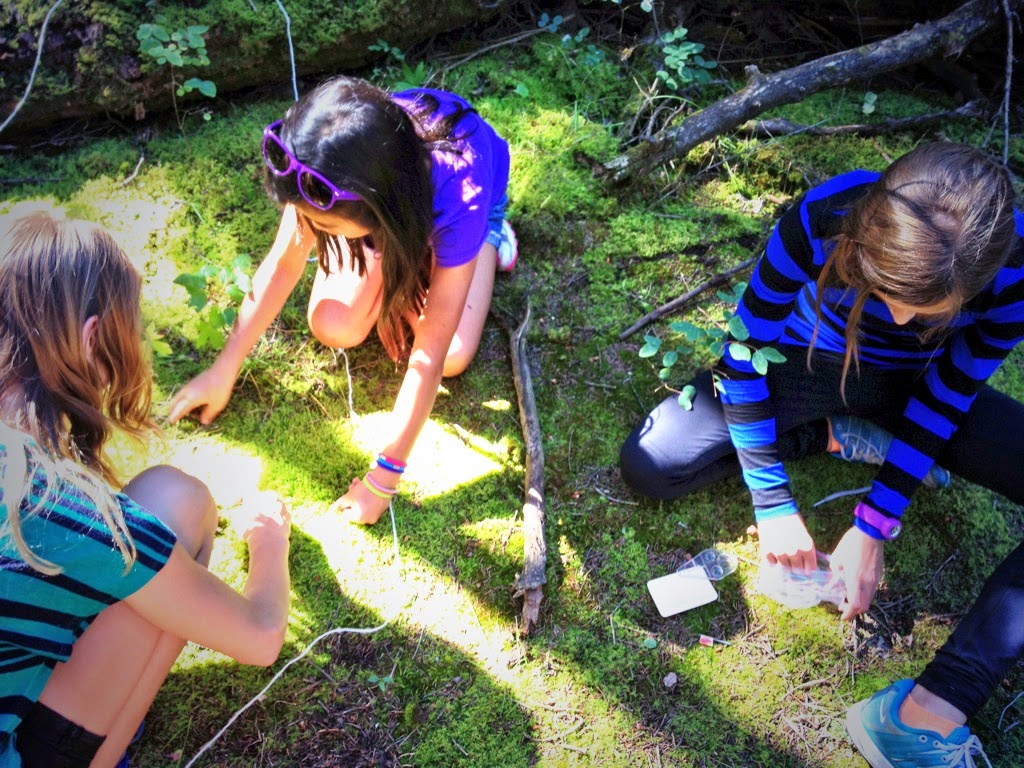 Here is a blog post that highlights some simple activities you can do with your students to get outside in the beautiful spring weather and have them investigating the natural world. These activities can be done in your school yard or in a nearby natural area.
 Since our early days the Calgary Science School has provided outdoor and environmental education experiences at Camp Sweet which is near Olds, Alberta. The camp, developed by former Calgary Science School principal Ron Sweet, has been used for the past 10 years to provide highly successful learning experiences for all CSS students in grades 4 to 9.
Each grade has two overnight camps per year where at least one of them is held at Camp Sweet. Our grade 7 students attended the 3-day and 2-night camp on their second week of school this year!
Science Communication Opportunity
Our Science Communication Club are looking for opportunities to share their knowledge and demonstrations this spring. We would like to support their hard work in helping to find schools, centres, malls or other venues where they can safely demonstrate some of what they have been working on this year.
If you are interested in hosting our club or have questions about the project, please email dan.m@connectcharter.ca

Student Learning Plans: Choosing a Platform
The Quest for the “Perfect” Platform at Connect
by Tanya Stogre and Abby Saadeh
Through formal and informal conversations with colleagues, students, parents, and administrators over the past two years we have determined the characteristics necessary in a platform for our student learning plans (SLP's). Although recognizing some classes at Connect house their SLP’s in binders and duotangs (as a paper format), we realized early on in our process that a digital platform was critical in ensuring information is easily transferable between and amongst all stakeholders. Asking questions such as: What are the different platforms available? And, what are the strengths and weaknesses of each? were important in our process to find a platform that would meet the majority of student, parent, and teacher needs. The specific characteristics we felt were most important to our school were the following:
- Security
- Access - ipad/laptop & home/parents/teachers
- User friendliness
- Transferability between grades & years
- Clear visual/clean...easy to view
- Good “fit” with our Exemplary Learning Framework (ELF) … re: its set-up (Please see our previous blog post discussing our ELF and SLP’s)
- Individuality/Personalization
- Cost
- Options
- Multimedia options
- Living/easy to edit or change
- Age appropriate features
Energy Diet- A student post
Our grade 4 and 7 classes are collaborating this year in the Classroom Energy Diet Challenge. The students have been assembled into small combined teams where each takes up the different challenges. Our grade 7 students have taken up these leadership roles, and below is a blog post written by a grade 4 and 7 pair. They could earn up to 15 points for their team!
Energy Diet (Letter to the editor)
By: T and P
What are different types of energy sources? And which one is best for our environment?
Sun
Solar panels generate electricity from the sun. The old solar panels were made of silicon and now solar panels are made from cheaper crystals but do not work as well as silicon. Solar power is made when the suns light hits the solar panel, the electrons in the silicon get up and move instead of just jiggling in place to make heat.
By: T and P
What are different types of energy sources? And which one is best for our environment?
Sun
 |
An Inquiry into Words and Spelling
-by Abby Saadeh
In an Inquiry based environment, we get excited and enveloped in our questions and ideas. At Connect Charter we want to take these opportunities to incorporate Spelling into our explorations and develop skills into our practice. Together with the Grade 4 Humanities team, we identified a need to develop some ideas on how to approach Spelling. I gave the students a Spelling Questionnaire that would give me more information about how they felt about Spelling and what they thought about themselves as Spellers. From the information gathered, I came up with the first discussion question, “What is Spelling?” And, “If we made Spelling important, what would it look like?” This is what the students came up with.
Class Brainstorm
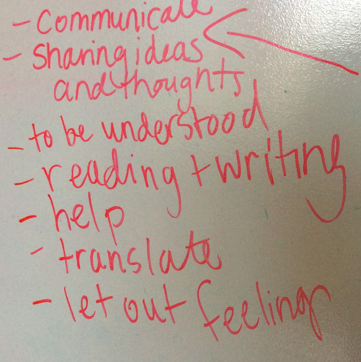
Next, we discussed words that they found interesting or were curious about because of the way they sounded or simply by the way they looked or how they sounded. I encouraged them to talk to each other about words that they found difficult, words that they continuously spelled wrong, or words that they spelled wrong in their previous assignments. We decided that we could get the words from anywhere, as long as they give reasons why they chose them, it could be from their writing, reading, signs, television...anywhere. We came up with a list of words that answered these questions and began to explore them.
In an Inquiry based environment, we get excited and enveloped in our questions and ideas. At Connect Charter we want to take these opportunities to incorporate Spelling into our explorations and develop skills into our practice. Together with the Grade 4 Humanities team, we identified a need to develop some ideas on how to approach Spelling. I gave the students a Spelling Questionnaire that would give me more information about how they felt about Spelling and what they thought about themselves as Spellers. From the information gathered, I came up with the first discussion question, “What is Spelling?” And, “If we made Spelling important, what would it look like?” This is what the students came up with.
Class Brainstorm
Next, we discussed words that they found interesting or were curious about because of the way they sounded or simply by the way they looked or how they sounded. I encouraged them to talk to each other about words that they found difficult, words that they continuously spelled wrong, or words that they spelled wrong in their previous assignments. We decided that we could get the words from anywhere, as long as they give reasons why they chose them, it could be from their writing, reading, signs, television...anywhere. We came up with a list of words that answered these questions and began to explore them.
Inquiry and Assessment in Inquiry: Views from an Internationally Trained Teacher
By Joanne Eloho~ Werklund School of Education Bridge to Teaching Program
 It was quite the experience partnering with Ms. Pereverzoff at the Connect Charter School, (formerly Calgary Charter School) to teach her seventh grade class in my first practicum as a Bridge to Teaching student from the Werklund School of Education. As an internationally trained teacher, I expected to find significant differences in Alberta classrooms and there was no surprise there, however, I have found that learning through inquiry is such an extreme deviation from my more traditional practice of teaching. For the first time in my practice, I was actively encouraging students to assume more responsibility for their learning and they were working to meet that expectation. I was stepping back and allowing them the opportunity to expand their knowledge by exploring the curriculum through their interests. Inquiry, from what I have experienced in five short weeks, is indeed an innovation in how we want our students to learn; ultimately as teachers our aim is to help students develop as independent, critical thinking citizens of society, inquiry not only initiates the process, it affords every student the opportunity to be independent and think critically by stressing the importance of the “Why” in whatever it is students are learning.

Underwater ROV Elective
 This term we offered students in grade 6 and 7 an Underwater ROV elective. In this elective students design, build and test an underwater Remotely Operated Vehicle, or ROV. ROVs are used for a variety of reasons, including marine biology research, military applications, underwater archeological exploration and more.
Students used PVC pipe, wires, 12 volt DC motors, batteries and other supplies to construct their ROV. Propellers were designed in Google Sketch Up and printed on our MakerBot 3D printer. In the end we found a propeller design online and printed several to provide students the best chance for success on testing day in the Mount Royal University pool.
Property of Air Demonstrations, Grade 6
-by Erin Couillard, Lisa Nelson, Carolyn Armstrong and Carly DeBoice
For our Aerodynamics and Flight unit this year, we decided to begin with students gaining an understanding of the properties of air, as outlined by the Alberta Program of Studies. To do this, students would be paired with a peer and assigned a property of air to investigate. They would then choose a demonstration that best explains/proves that specific property of air.
 To begin with, we chose a small demonstration to do for them. This had two purposes. First, to construct a criteria around what an effective science demonstration looks like and second, to start digging into the properties of air. The demonstration we chose was to prove the existence of oxygen in the air by lighting two candles and then placing a jar over one of them. Students predicted what would happen and then attempted to explain why it happened and to indicate the property of air that it proved.
After observation and discussion, students co-constructed the following criteria around “What makes an effective Science demonstration”:
• Facing Audience
• Speaking loudly with enthusiasm and inflection
• Knowing your information
• Proving something with visual evidence
• Explaining each step
• Asking audience to make a prediction, giving them time to think
• Asking audience “Why”?
• Asking audience for observations
 Next, students will practice their demonstration to gain feedback from peers, teacher and parents (at student-led conferences) prior to creating a video of their demonstration for final assessment and sharing. Throughout this process each group will gain an understanding of all of the properties of air through learning how to write observations and conclusions. We will also be co-constructing criteria around observations and conclusions to ensure that each student has an understanding of the expectations. Stay tuned for more blog posts as we work our way through the unit(s).
Up next!
• Wind tunnel engineering project (see blog posts from previous years here and here)
• Parachute Design
• Paper Glider experiments
What are you doing for your Aerodynamics and Flight units? We would love to know!
For our Aerodynamics and Flight unit this year, we decided to begin with students gaining an understanding of the properties of air, as outlined by the Alberta Program of Studies. To do this, students would be paired with a peer and assigned a property of air to investigate. They would then choose a demonstration that best explains/proves that specific property of air.
To begin with, we chose a small demonstration to do for them. This had two purposes. First, to construct a criteria around what an effective science demonstration looks like and second, to start digging into the properties of air. The demonstration we chose was to prove the existence of oxygen in the air by lighting two candles and then placing a jar over one of them. Students predicted what would happen and then attempted to explain why it happened and to indicate the property of air that it proved.After observation and discussion, students co-constructed the following criteria around “What makes an effective Science demonstration”:
• Facing Audience
• Speaking loudly with enthusiasm and inflection
• Knowing your information
• Proving something with visual evidence
• Explaining each step
• Asking audience to make a prediction, giving them time to think
• Asking audience “Why”?
• Asking audience for observations
Next, students will practice their demonstration to gain feedback from peers, teacher and parents (at student-led conferences) prior to creating a video of their demonstration for final assessment and sharing. Throughout this process each group will gain an understanding of all of the properties of air through learning how to write observations and conclusions. We will also be co-constructing criteria around observations and conclusions to ensure that each student has an understanding of the expectations. Stay tuned for more blog posts as we work our way through the unit(s).Up next!
• Wind tunnel engineering project (see blog posts from previous years here and here)
• Parachute Design
• Paper Glider experiments
What are you doing for your Aerodynamics and Flight units? We would love to know!
Master Chef Electricity Challenge, Grade 9
 -by Louis Cheng and Cindy Nilsson
Today the grade 9 students were given a series of instructions to complete a Master Chef Electricity Challenge.
In teams of four, they were provided a box of electrical supplies and had 10 minutes to begin researching how to build some circuits. After their research time, they had to put away their laptops and textbooks to attempt to build the following: